
What to Do When Wildfire Smoke Arrives
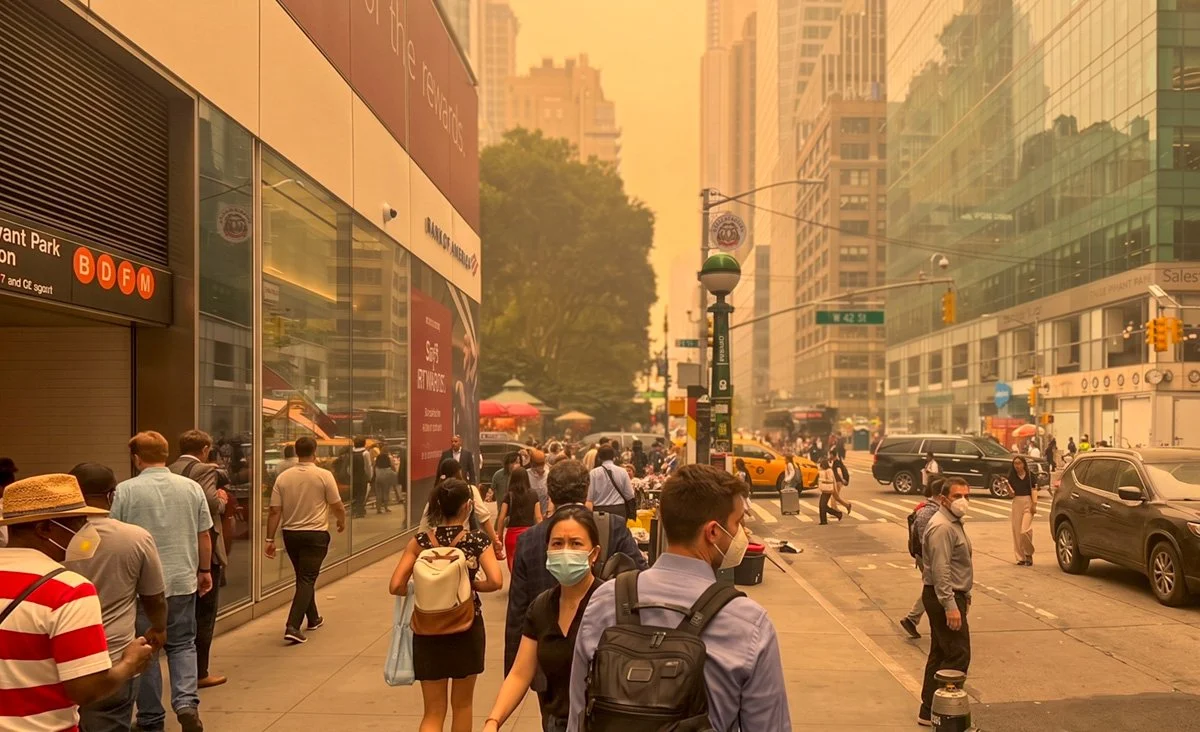
Midtown Manhattan on July 15th , 2026. Photo by reBuild Workshop
Wildfire smoke can push air quality to hazardous levels within hours, and it travels - a fire hundreds of miles away can settle over a city that has never had one.
We work in New York, where the last few summers have made this a recurring condition rather than a freak event, but nothing below is specific to here. It applies to any building, anywhere the air outside is worse than the air in.
Below is the short list - what to do in any building, and one thing that's specific to Passive House homes.
If you've landed here mid-event, skip to the list. The explanation is underneath it.
In any building
Shut every window and exterior door. Window AC units are the common gap. Check the perimeter of the unit and seal what you can.
Turn off kitchen hood fans and bathroom exhaust fans. These are exhaust-only, which means they pull outside air into the building through every leak in the envelope to replace what they push out. During a smoke event that's exactly wrong.
Run an air purifier with HEPA and carbon filtration, continuously. Check that the filter is clean first - a clogged filter provides little protection, and this is the moment you'll wish you'd changed it. HEPA handles the particulate; carbon handles the smell and some of the gases.
Skip anything that adds to the indoor load. Frying, candles, non-venting dryers. You've sealed the building; whatever you generate inside stays inside.
Your regular AC is fine to run. It recirculates indoor air rather than drawing from outside. But its filter was never designed to capture particulate this fine, so it isn't doing the cleaning. That's the purifier's job.
If you have a CO2 monitor, watch it. Sealed up, the number climbs — that's the tradeoff you've accepted. 1,500 ppm is a reasonable ceiling before you ventilate briefly.
If you live in a Passive House
Your airtight envelope is a real advantage during a smoke event. It's doing what it was designed to do.
One change: turn off the ERV. Even with a high-grade MERV-13 filter installed, outdoor PM2.5 at hazardous levels exceeds what any filter can fully scrub. Stopping the fresh air intake is the right call until outdoor conditions improve.
Everything on the list above still applies, though the stakes are lower than in a conventional house.
After it clears
Replace the filters in your purifier and your ERV. They've been working hard, and a saturated filter is worse than no filter - it restricts airflow and can off-gas what it captured.
Then, if the last few summers are any indication, note where the leaks were. The rooms that got smoky first are the rooms with the envelope problems, and that's useful information whether or not you ever do anything about it.
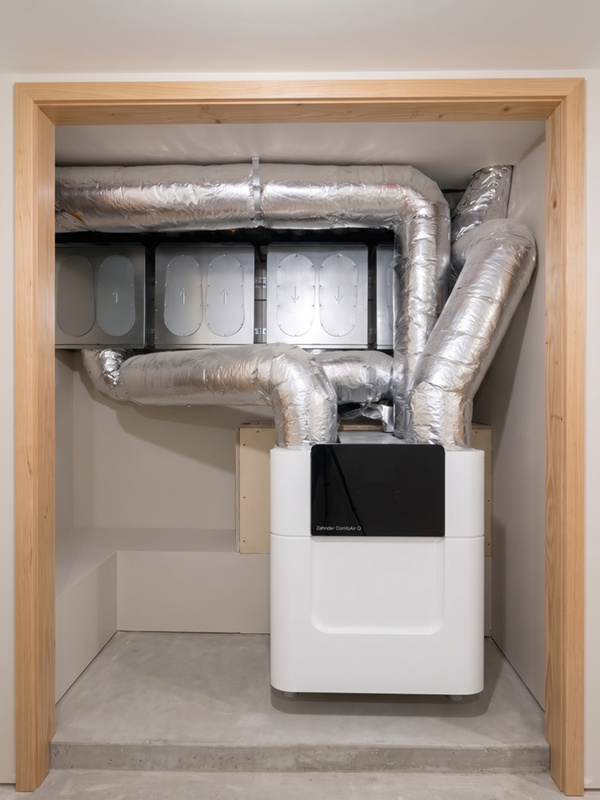
Energy recovery ventilator (ERV), installed at one of our Passive House Projects.
An ERV is a mechanical ventilation system that continuously brings in fresh outdoor air while exhausting stale indoor air.